JOYup is an innovative English learning app built around CEFR levels.
Why is JOYup effective for learning English?
The JOYup world makes learning English feel natural
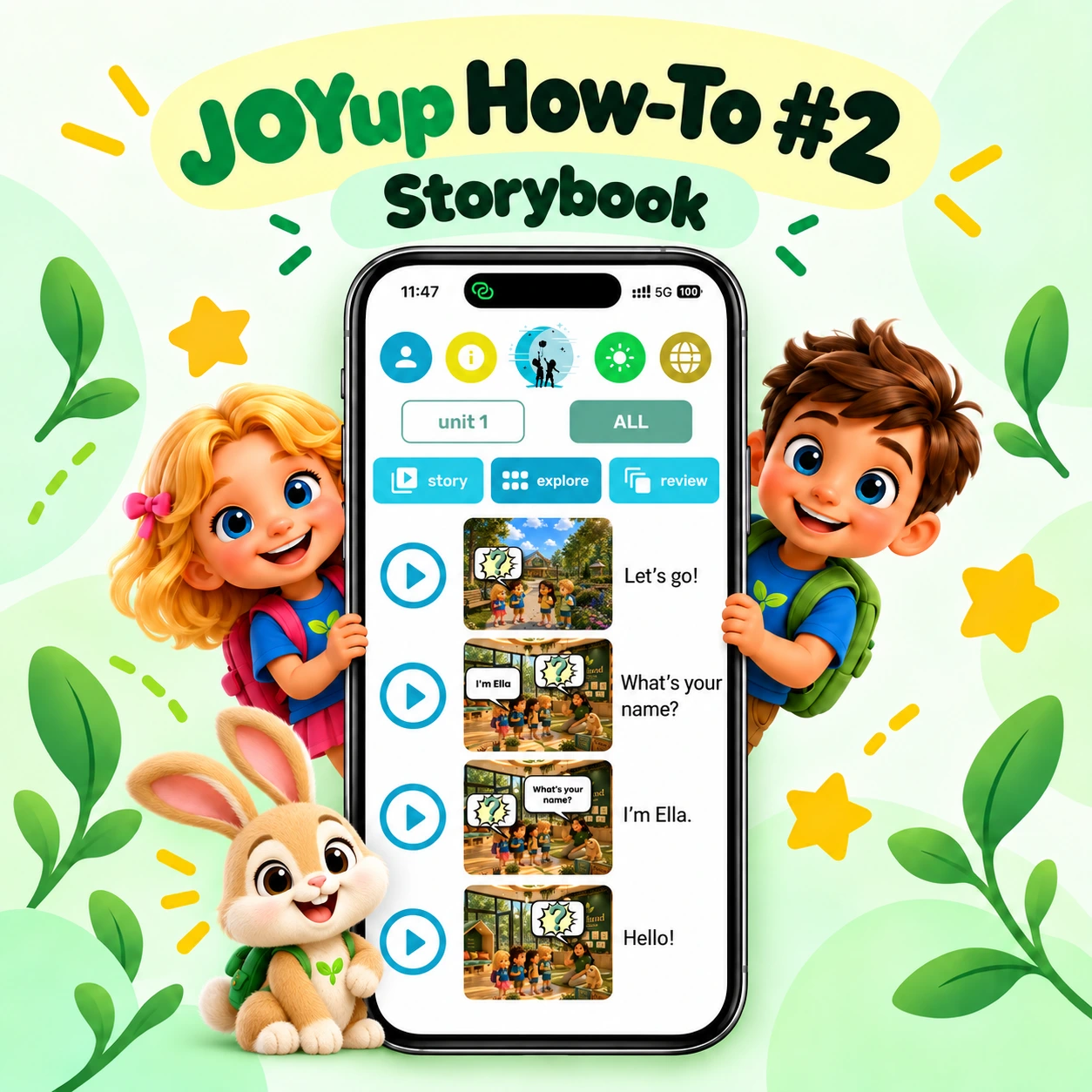
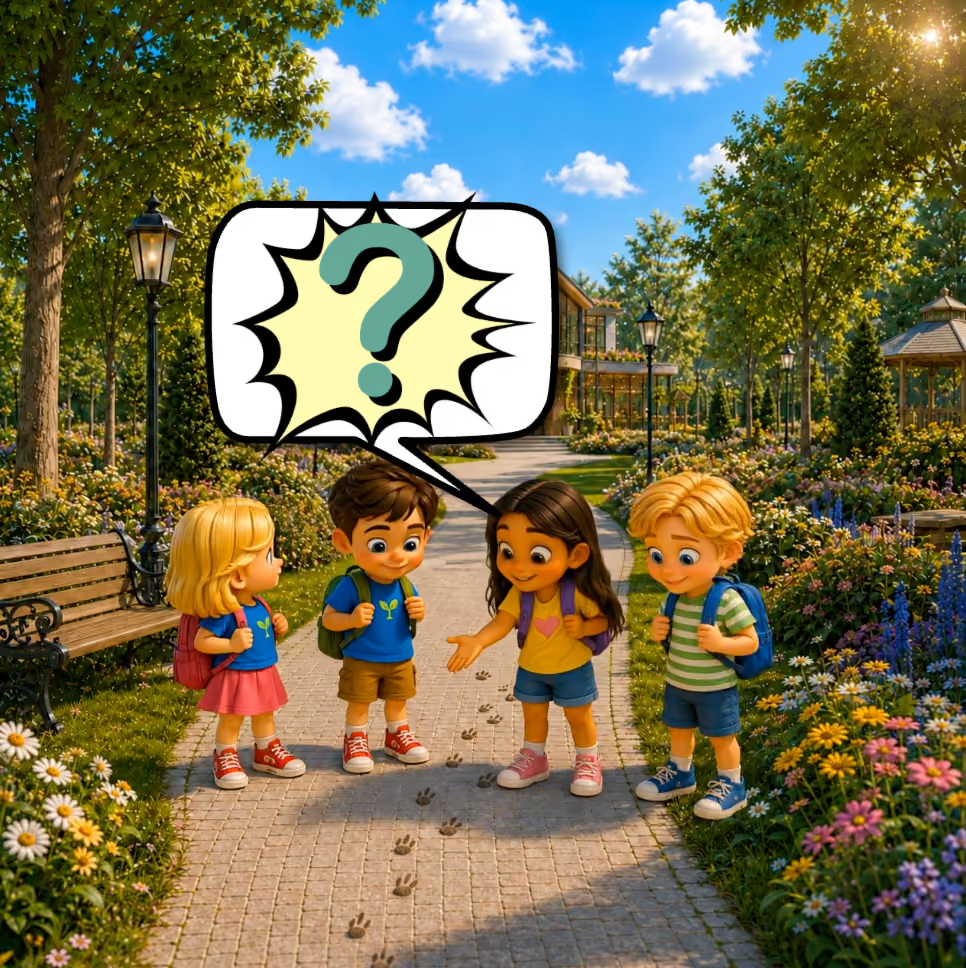
Every new lesson begins with a story following the latest adventures of the JOYup characters. Children develop their skills through a structured CEFR-based programme, from pre-A0 all the way to C2. The JOYup characters grow alongside learners, sharing their joys, challenges and more difficult moments. This way, children learn not only English, but also how to recognise emotions and handle different situations.
Your child really starts speaking
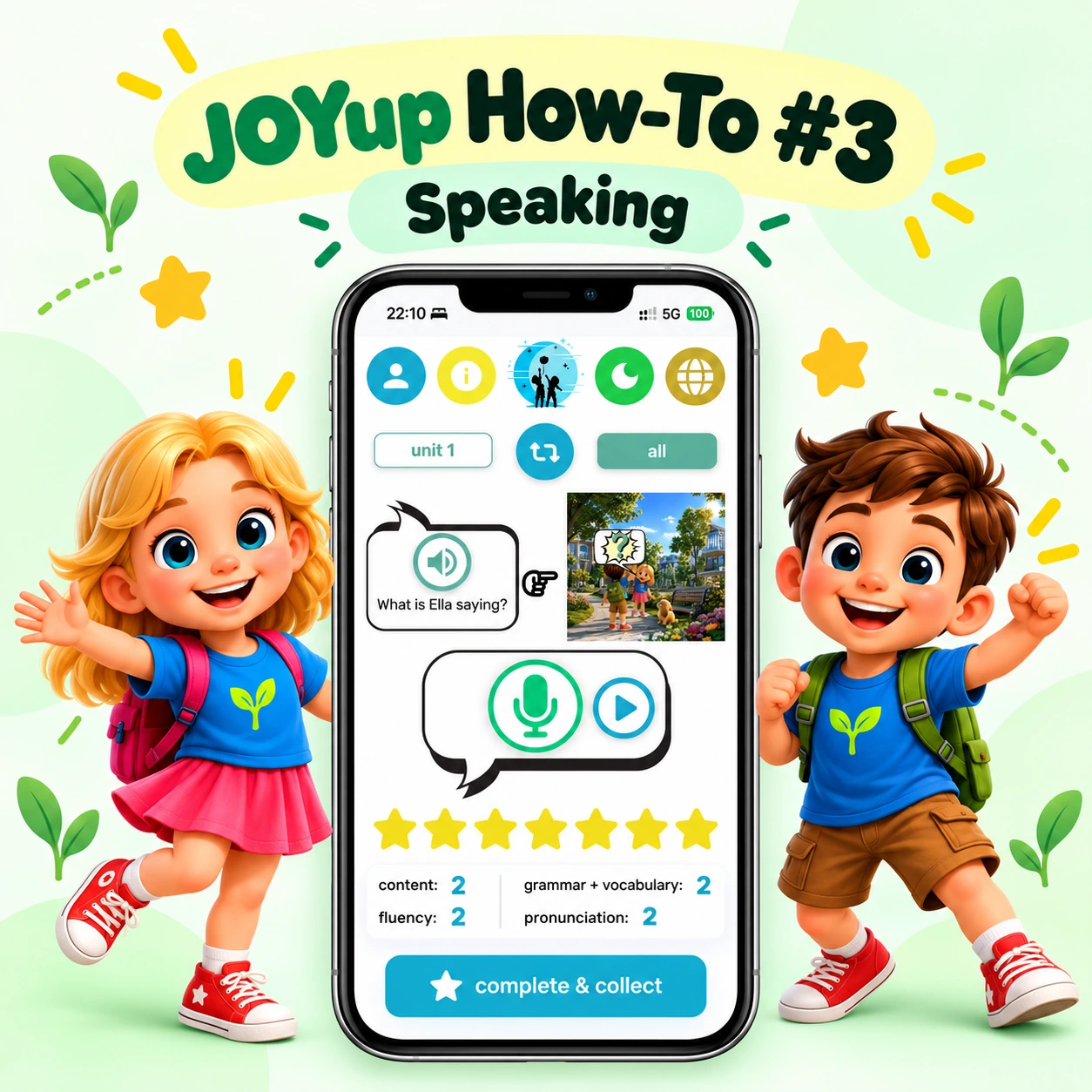
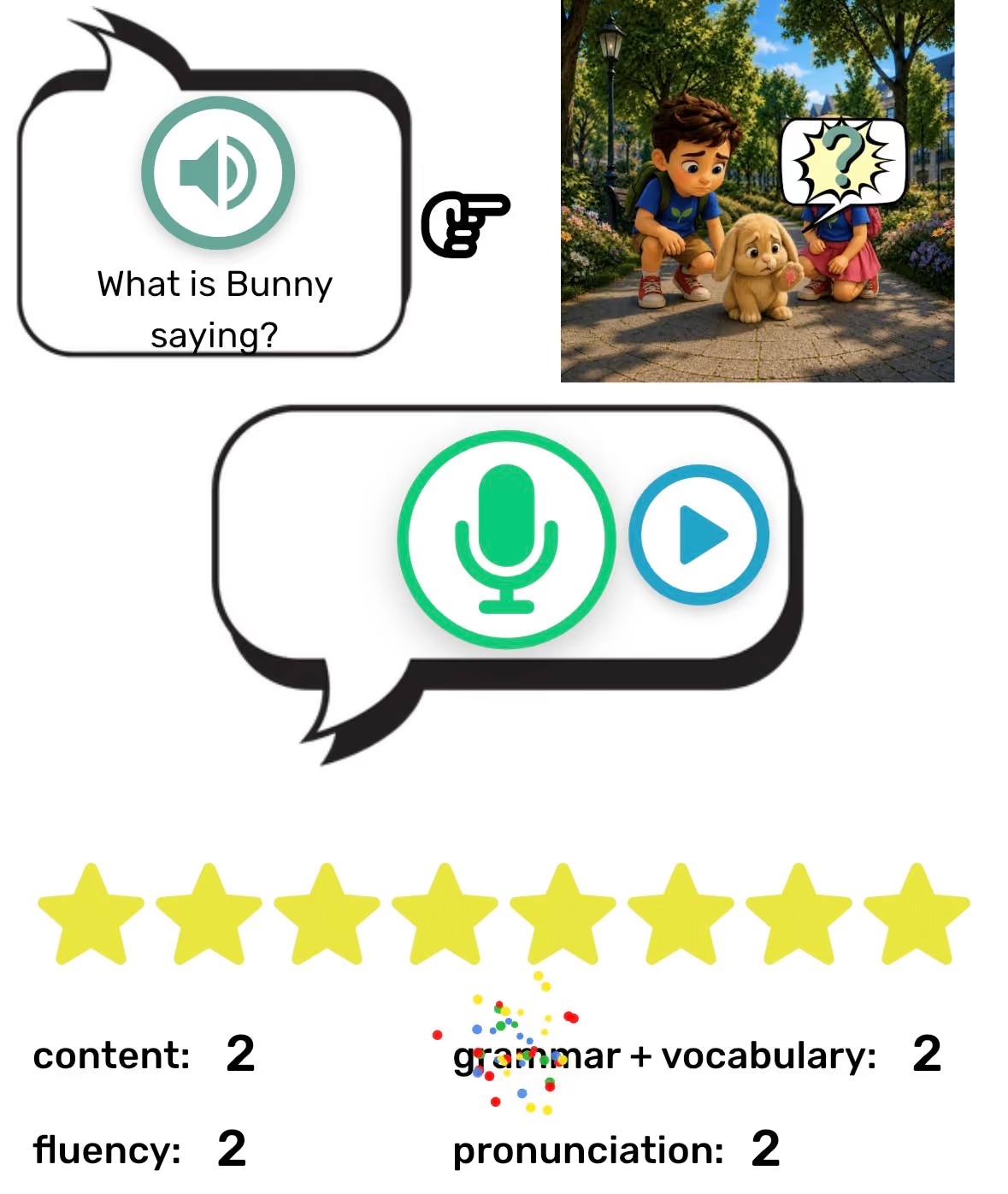
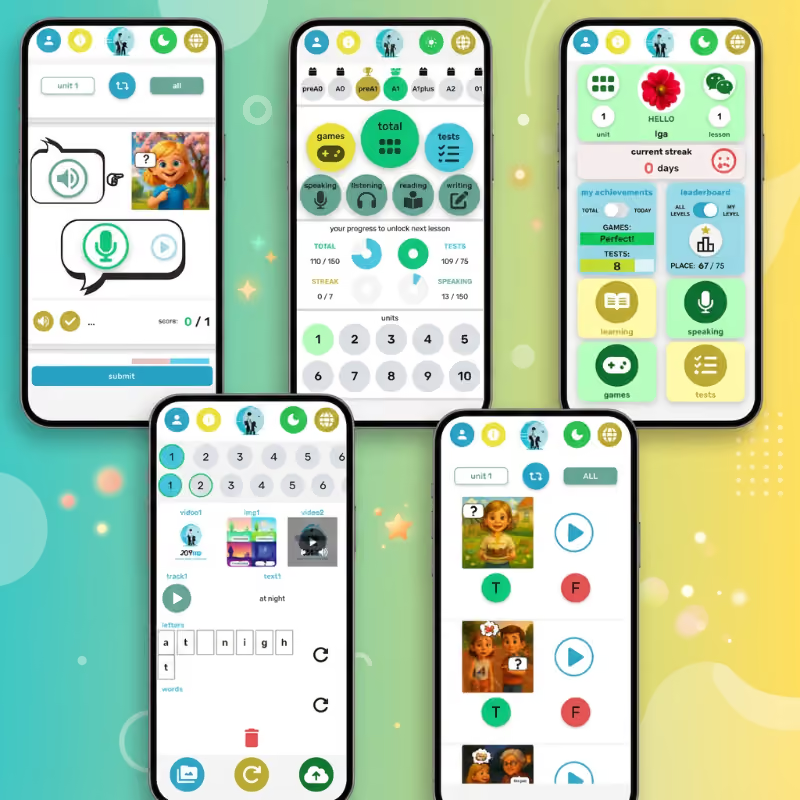
Practise speaking, not just tapping. In JOYup, children do more than choose the correct answer — they actively speak English. In the Speaking section, they answer questions based on illustrations and previously learned material, record their response and receive instant feedback on pronunciation and how well their answer matches the task. They can try again as many times as they need, improve at their own pace and gradually build confidence in speaking. This makes speaking a natural part of every lesson rather than an occasional extra exercise.
A variety of games and exercises
JOYup games and exercises follow a structured curriculum, just like materials used in textbooks and traditional language courses. The difference is that children develop their skills in a much more engaging way — through level-appropriate tasks, interactive activities and different ways of playing with English. This gives learners regular practice in vocabulary, comprehension, reading, listening and using familiar language structures, while allowing them to learn in ways they enjoy most. The Daily Challenge adds extra motivation by encouraging regular contact with English every day.
From preschool to high school
JOYup grows with your child, guiding them through every stage of learning English — from pre-A0 all the way to C2. The programme follows CEFR levels and develops all four key language skills: speaking, listening, reading and writing. As learners progress, the topics, language, tasks and characters evolve too, keeping the content appropriate for their age and ability. JOYup also supports preparation for Cambridge English exams by gradually introducing learners to the skills and task types they will encounter.
Progress you can see every day
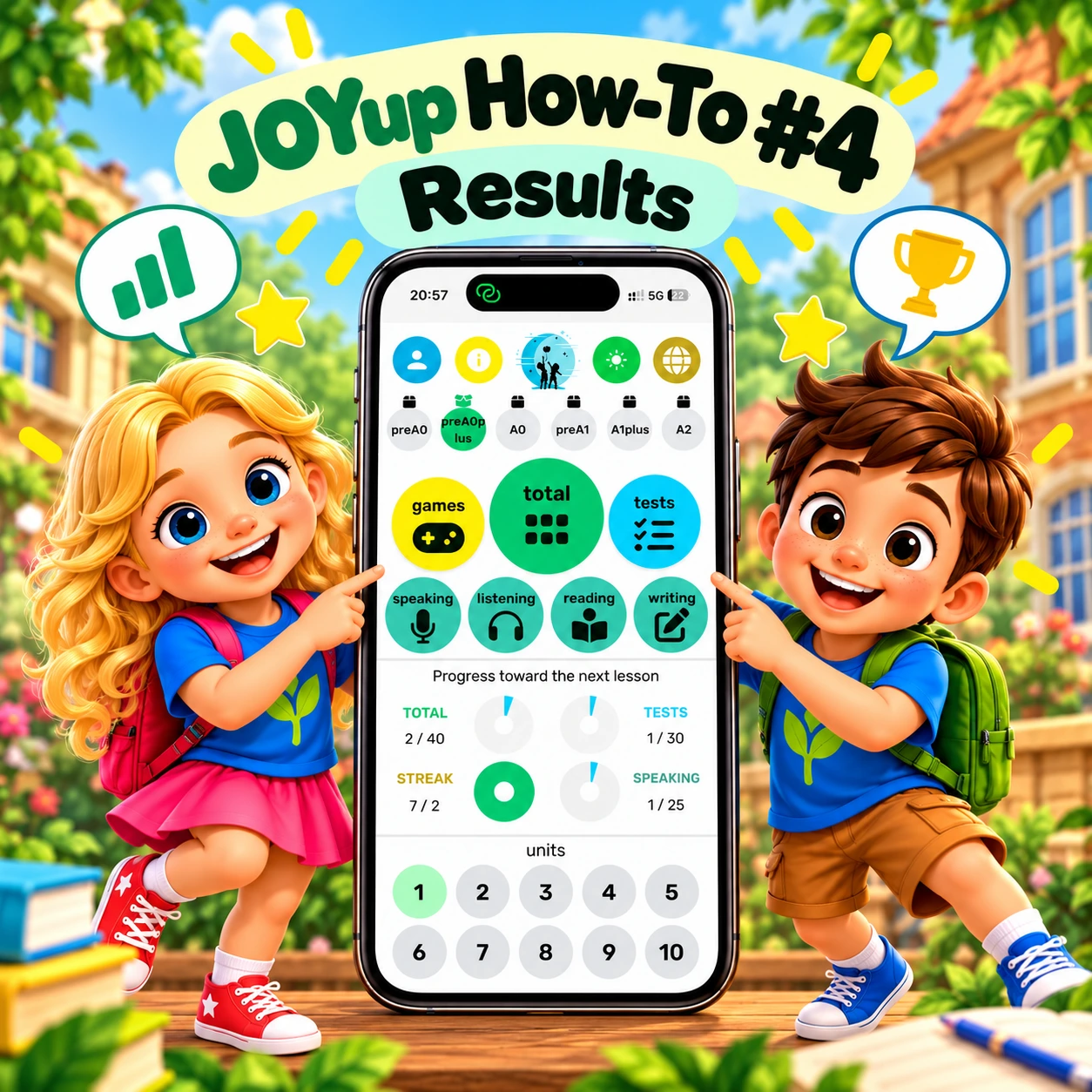
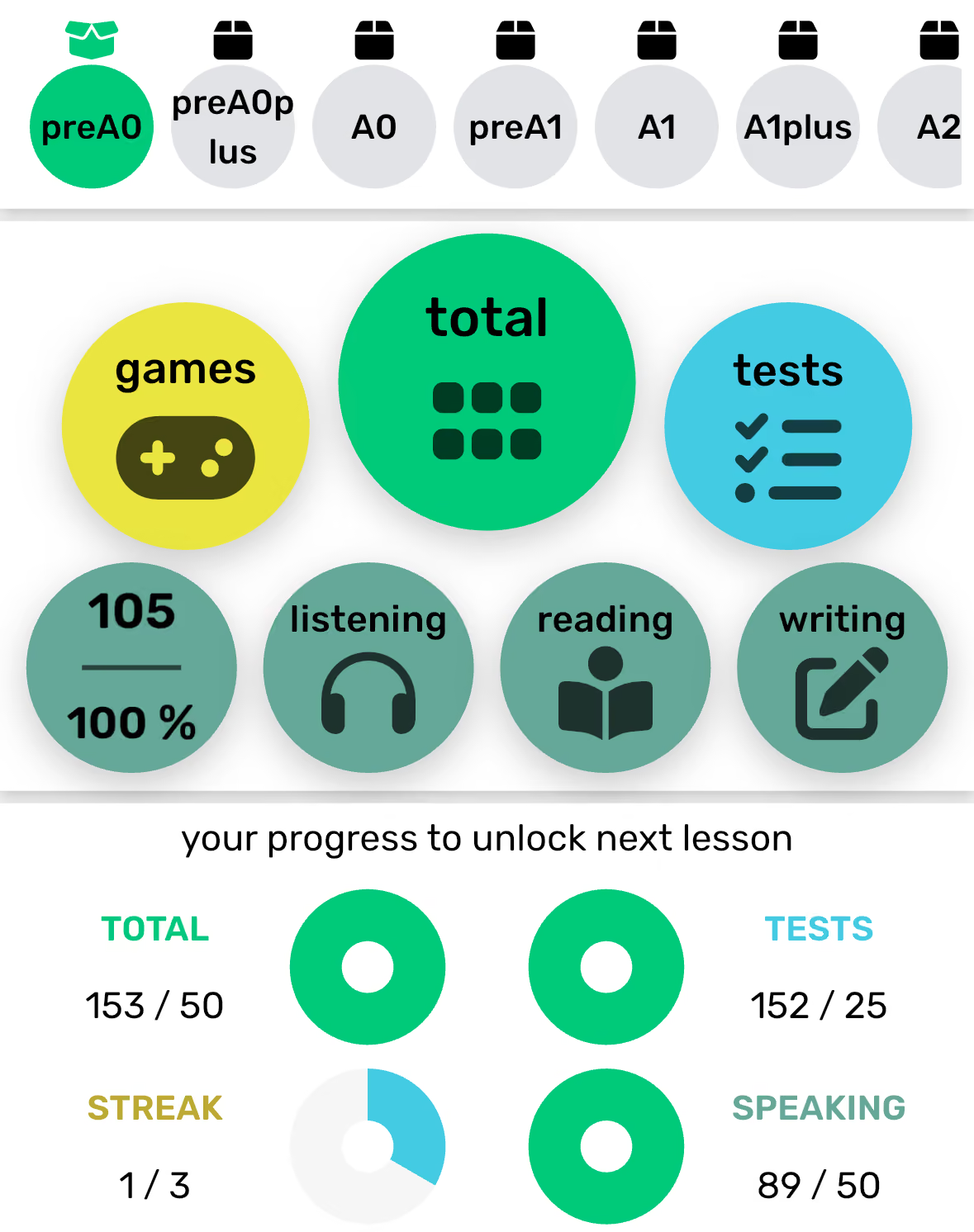
In JOYup, children earn points for regular learning and for developing specific language skills such as speaking, listening, reading and writing. JOYup stars, progress goals and leaderboards add elements of gamification that encourage consistent learning. Every course also clearly shows the skills learners can develop by completing it. Parents can create a free parent account and access a clear overview of their child’s progress. Results make it easy to see both strengths and areas that would benefit from more practice.
A next-generation English course
JOYup combines an ambitious programme from pre-A0 to C2 with an accessible and engaging experience designed specifically for young learners. Unlike many apps focused mainly on vocabulary and choosing correct answers, JOYup puts strong emphasis on active speaking, developing all language skills and using English in practice. The programme is designed to provide comprehensive learning comparable to a complete language course — structured, always available and adapted to each learner’s pace.
• Understanding basic words and very short phrases supported by pictures, gestures or context. • Responding to very simple instructions: Look! Listen! Stand up! Let’s go! • Naming familiar people, animals, objects, colours and basic actions. • Responding with a single word or a short memorised phrase. • Repeating simple words and sentences and developing accurate pronunciation. • Recognising familiar words when heard and matching them to pictures. • Beginning to recognise letters, sounds and written words.
• Understanding simple words, phrases and very short sentences about familiar situations. • Responding to simple questions and instructions, e.g. What’s this? Where is Bunny? Show me… Come here. • Using familiar words and short phrases to communicate basic information, e.g. It’s a cat. I’m Ella. I like apples. • Talking about colours, numbers, toys, animals, family, food and objects from everyday surroundings. • Understanding very short dialogues and stories supported by pictures and context. • Combining familiar words to form first simple sentences. • Recognising and reading familiar words and very short phrases. • Writing individual familiar words and completing very simple sentences. • Using first language patterns, e.g. It’s…, I’m…, I like…, I can…, This is…, my/your, a/an, plural -s, in/on/under.
• Understanding and using very short sentences about familiar situations, e.g. I’m Ella. I like cats. This is my bag. • Introducing yourself, giving your age and sharing basic personal information. • Asking and understanding very simple questions, e.g. What’s your name? What’s this? Where is Bunny? • Talking about family, animals, toys, food, colours, school and everyday activities. • Understanding short dialogues and simple instructions. • Reading individual words and very short sentences supported by pictures. • Writing familiar words and short phrases. • Using first structures, e.g. I am…, I like…, I can…, This is…, my/your, a/an, plural -s, in/on/under.
• Understanding and forming simple sentences about immediate surroundings, e.g. This is my book. It’s colourful. The cat is under the table. • Asking simple questions and giving short answers, e.g. What’s this? Where is…? How many…? Have you got…? • Talking about yourself, family, home, toys, school, food, clothes, animals and interests. • Describing people, objects and simple pictures. • Understanding short conversations about familiar situations. • Reading short illustrated texts and finding basic information. • Writing simple words, phrases and sentences. • Using basic structures: to be, have got, can/can’t, there is/are, this/that, these/those, my/your/his/her, plural -s, basic prepositions and the Present Simple.
• Understanding simple conversations, descriptions and instructions about everyday life. • Taking part in short conversations and asking questions about everyday matters. • Talking about yourself, family, school, hobbies, home, holidays, weather and everyday activities. • Describing what is happening now and what usually happens. • Talking about past events using simple sentences. • Reading short stories, messages and descriptions and answering questions about them. • Writing several connected sentences about a familiar topic. • Using structures including the Present Simple, Present Continuous, can/could, have got, there is/are, basic Past Simple, possessives, comparatives, adverbs and prepositions.
• Understanding longer sentences and short conversations without needing to understand every word. • Taking part in short conversations and independently maintaining simple interactions. • Telling stories and describing events in a logical sequence. • Describing experiences, plans, people, places and situations. • Expressing simple opinions, preferences and reasons, e.g. I think…, because…, I prefer… • Reading short stories, emails, messages and simple informational texts. • Writing short messages, descriptions and stories made up of several connected sentences. • Using a wider range of structures: Past Simple, Present Continuous, comparatives/superlatives, going to, must/mustn’t, should, some/any, much/many and because/so/when.
• Understanding commonly used language related to school, family, shopping, travel, interests and everyday needs. • Managing simple, routine communication situations. • Taking part in short conversations, asking follow-up questions and responding to the other speaker. • Talking about past events as well as plans and predictions for the future. • Describing experiences, people, places, interests and everyday problems. • Understanding short emails, notices, instructions, stories and simple articles. • Writing short emails, messages, descriptions and stories. • Using structures including Past Simple, basic Present Perfect, going to/will, comparatives/superlatives, countable/uncountable nouns, must/have to/should, basic conditionals and because/so/when/if.
• Understanding the main meaning of longer spoken texts on familiar topics. • Having more natural conversations without preparing every response in advance. • Describing experiences and events in greater detail. • Expressing opinions and giving simple arguments and reasons. • Handling most basic situations while travelling. • Reading longer stories, articles and informational texts. • Writing organised texts consisting of several paragraphs. • Using past, present and future forms more confidently, together with the Present Perfect, first conditional, modal verbs, relative clauses and a wider range of linking words.
• Understanding the main points of clear speech about school, interests, travel and everyday life. • Taking part in conversations on most familiar topics without preparation. • Describing experiences, events, dreams, plans and ambitions. • Expressing personal opinions and briefly explaining your point of view. • Telling stories and recounting events in a logical sequence. • Understanding straightforward articles, news items, blog posts, stories and texts about areas of interest. • Writing coherent emails, stories, descriptions and opinion texts. • Using structures including the Present Perfect, Past Continuous, first conditional, modal verbs, relative clauses, basic passive voice and reported speech.
• Understanding longer conversations, podcasts and videos on familiar topics. • Speaking more spontaneously and actively maintaining a discussion. • Describing experiences in detail and explaining personal views. • Presenting advantages, disadvantages, causes and consequences. • Summarising the key information from material that has been read or heard. • Reading longer articles and stories and understanding the author’s intentions. • Writing organised argumentative texts, stories, emails and articles. • Using a wider range of structures, including conditionals, passive voice, reported speech, modal verbs, gerunds/infinitives and relative clauses.
• Understanding the main ideas of complex spoken texts and a wide range of authentic materials. • Interacting with other English speakers with a good degree of fluency and spontaneity. • Participating actively in discussions and defending a point of view. • Presenting arguments, advantages, disadvantages and possible solutions in detail. • Understanding articles, reports, stories and contemporary literary texts. • Recognising the opinions, attitudes and intentions of a writer or speaker. • Producing clear, detailed texts including articles, essays, reviews, reports, emails and stories. • Using the main tenses and more complex structures confidently, including conditionals, passive voice, reported speech, modal deduction, gerunds/infinitives and complex relative clauses.
• Understanding fast, natural conversations and increasingly complex audio and video content. • Participating fluently in discussions, including those on less familiar topics. • Presenting and developing arguments precisely. • Adapting language to the situation and audience. • Understanding implied meaning and a growing range of idiomatic expressions. • Analysing and comparing information from several sources. • Producing extended, coherent and well-organised texts. • Using a wide range of grammatical structures with increasing control and naturalness.
• Understanding long and demanding spoken and written texts, even when meaning is not stated explicitly. • Using English fluently and spontaneously without frequently searching for words. • Using language flexibly in social, academic and professional situations. • Expressing complex ideas, arguments and relationships precisely. • Understanding long articles, literature and more specialised materials. • Recognising tone, style, irony, implications and the author’s intentions. • Producing extended, logical and stylistically appropriate written texts. • Using a wide range of vocabulary, idioms, collocations and advanced structures with a high degree of accuracy.
• Understanding virtually every type of spoken and written language, including very fast, idiomatic or abstract language. • Easily understanding subtle differences in meaning, humour, irony and cultural references. • Expressing yourself spontaneously, very fluently and precisely even on complex topics. • Flexibly adapting style, tone and register to the audience and situation. • Synthesising information and arguments from multiple sources. • Presenting complex topics clearly, logically and convincingly. • Producing sophisticated texts with a high degree of coherence, precision and stylistic naturalness. • Demonstrating excellent grammatical control, a rich vocabulary and confident use of subtle linguistic nuances.






.avif)
.avif)