The JOYup method is a modern approach to learning English entirely within the JOYup app. It is based on knowledge, practical experience, and observations of how children really learn. At its core are three steps: PEAK, TWEAK and KEEP. These three stages shape the way learning is designed throughout the JOYup app.
JOYup does not teach language as a list of words and rules to memorise. JOYup treats language as a tool for communication, play, action, and building confidence. That is why the app combines English learning with emotions, images, sound, repetition, and active use of the language.
The foundations of our method draw on neuroeducation and neurolinguistics. Neuroeducation shows that children learn more effectively when they are curious, engaged, and not overwhelmed by too much information. Neurolinguistics highlights that language is retained most effectively when it is used meaningfully, in context and in real communication — not only in isolated exercises.
Children do not learn a language simply by listening to explanations. For new words and structures to become something they can actually use, the brain needs repeated exposure, different types of input, and situations in which the language has meaning.
That is why JOYup combines:
images, sound, movement, emotions, repetition, and independent language use.
As a result, learners do not simply “know” a sentence — they gradually begin to use it. The Learning section is divided into three stages:
Step 1 – Every lesson introduces a new story featuring the adventures of the JOYup characters. Key words and expressions appear in speech bubbles.
Step 2 – Learners explore an interactive list of the words, sentences, and expressions they have encountered. Every item can be heard, seen, and read.
Step 3 – New language structures are reinforced in long-term memory through memory cards, commonly known as flashcards. JOYup takes traditional flashcards a step further: learners can choose from three types of cards and decide which side they want to start with when checking their own knowledge.
This is what the JOYup method is built around: first we spark curiosity, then we play and experiment with the language, and finally we reinforce it through practice.
We all know that positive emotions and genuine curiosity play an important role in learning. They encourage children to engage with a new topic and make them more willing to continue working with the material.
During the PEAK stage, we use engaging illustrations, original JOYup videos, audio materials, and characters that learners can relate to. New material is therefore not introduced as a dry list of vocabulary. Instead, it becomes part of a story, a situation, and the JOYup world that children want to explore.
From a neuroeducation perspective, this stage is particularly important because it helps activate attention and curiosity. Without attention, effective learning cannot take place. When a child is interested, the brain is better able to identify important information and is more willing to return to it in later activities.
From a neurolinguistic perspective, it is equally important that language appears in context from the very beginning. Learners see the situation, hear what is being said, observe the characters’ emotions, and begin to understand why a particular language structure is being used.
We therefore do not teach a sentence as an isolated construction. We show it as something that helps learners say something, ask a question, respond, or tell a story.
In the second stage of the JOYup method, learners explore the language introduced in the videos at their own pace. Each structure is presented in a way that uses both sight and sound to help reinforce new material as effectively as possible or refresh structures learned earlier.
Learners can see the word or sentence, hear how it sounds, and return to it as often as they need. This gives them time to notice details, become familiar with pronunciation, and gradually build stronger connections between meaning, sound, and written language.
The final stage of the JOYup method has three main goals: to consolidate new material, check how well new structures have been understood, and strengthen learners’ confidence.
At this stage, learners begin to use familiar sentences and structures independently at the appropriate moment. However, this is not traditional testing, which children often associate with stress. In JOYup, knowledge is checked through games, playful activities, communication tasks, and practical language use.
This is important because the goal of language learning is not simply to remember a sentence. The goal is to be able to use it when it is needed.
From a neuroeducation perspective, the KEEP stage supports long-term retention by returning to previously learned material, encouraging active recall, and applying knowledge in practice. In the app, learners can begin with interactive flashcards or move directly to games and exercises to earn the required number of points and unlock the next video featuring a new JOYup adventure.
From a neurolinguistic perspective, this stage supports the transition from controlled language use towards increasingly natural communication.
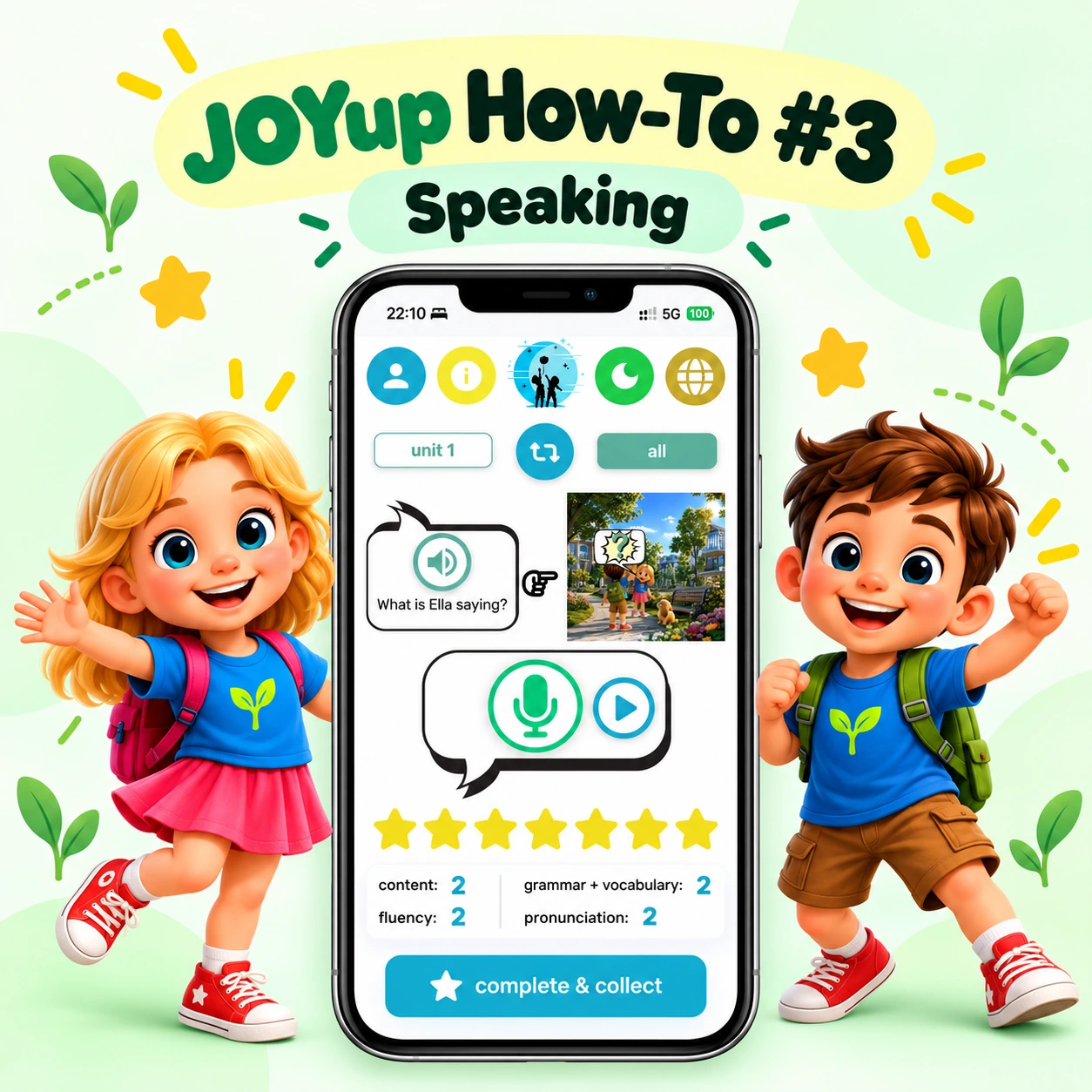
Learners begin to respond, choose appropriate words, and build their own spoken responses.
The JOYup app was designed to make high-quality English learning more accessible than traditional language courses while keeping the cost significantly lower. It gives learners the opportunity to engage with English every day, with the language always close at hand and presented in an interesting, motivating way.
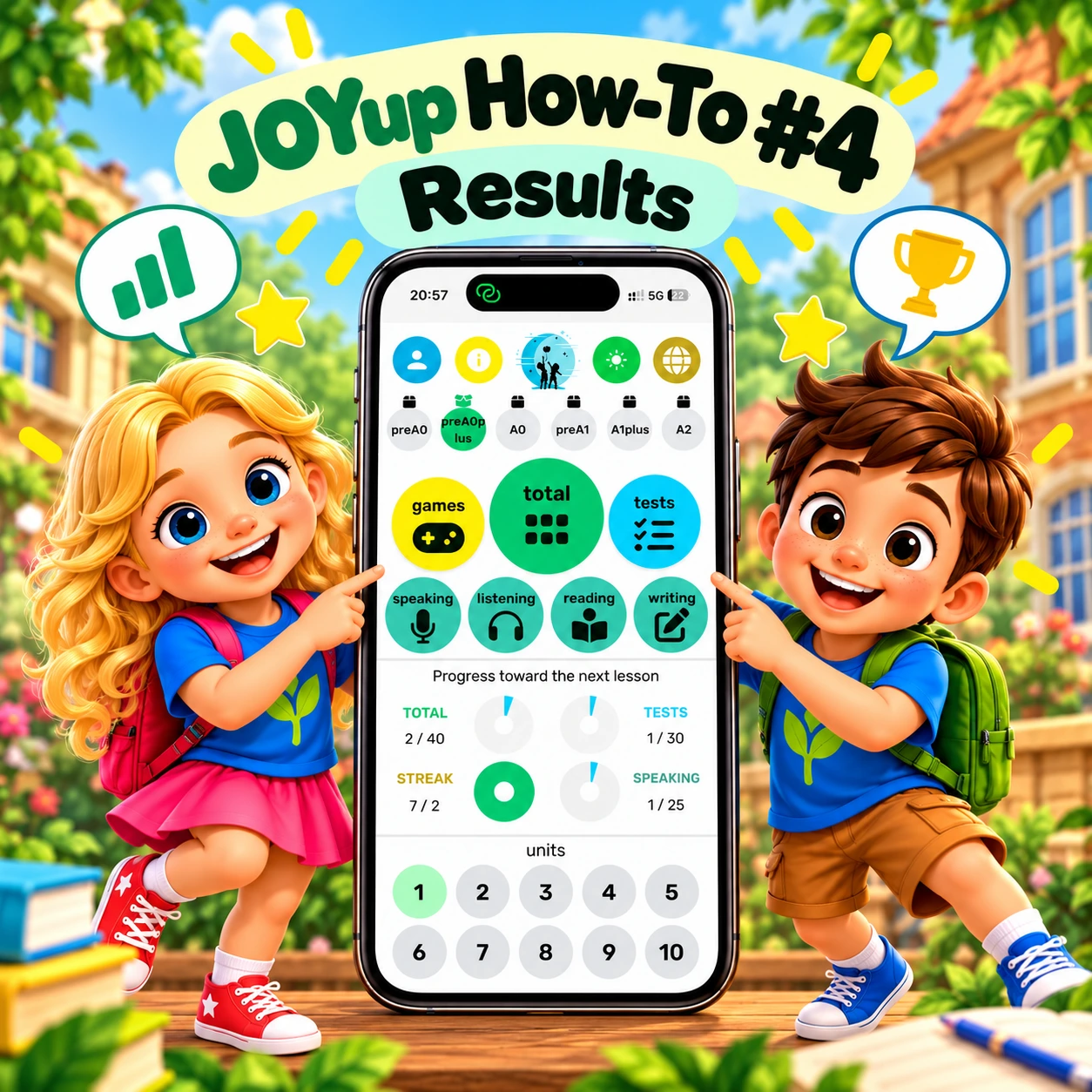
In the app, learners can reinforce material through games, activities, tests, recordings, images, and exercises aligned with the course programme. The leaderboard provides additional motivation by allowing learners to follow their progress and compete in a safe and encouraging way.
In the Games section, every answer receives immediate feedback. This matters because children do not have to wait to find out whether they have understood the material correctly. Instant feedback helps them correct mistakes more quickly and reinforce correct responses.
The Tests section reflects exercise formats aligned with the Cambridge curriculum and offers a modern alternative to traditional textbooks, which often remain in school bags and do little to encourage regular practice.
Parents can follow their child’s progress through their own dashboard after creating a free parent account.
Traditional language learning often begins with explanation, exercises, and memorisation. In JOYup, we begin with curiosity, emotion, and context.
We do not immediately ask a child, “Can you do this already?” First, we show them that language can be interesting, useful, and safe. Only then do we gradually increase the level of independence.
This approach reflects the way children naturally learn language. First, they listen, observe, connect situations with emotions, and notice patterns. Later, they repeat, experiment, play with words, and gradually begin to say more and more themselves.
JOYup deliberately builds on this natural process. That is why lessons in the app are dynamic, but never random. They are full of play, but follow a clear structure. They are enjoyable, while still leading towards specific learning outcomes.