The best app for learning English is one that does more than simply present vocabulary and exercises — it genuinely supports the learning process. It should combine an effective curriculum, daily motivation, practical language use, and clear information about a child’s progress.
That is exactly how the JOYup app was designed.
JOYup is not a random collection of games. It is a comprehensive tool for independent English learning, created to give children regular contact with the language, help them reinforce what they have learned effectively, and build confidence in speaking English.
At JOYup, we believe that effective language learning is about much more than memorising words. Children need context, repetition, positive emotions, immediate feedback, and plenty of opportunities to use the language actively. That is why the app combines learning, play, testing, speaking, and progress tracking.
The levels in the JOYup app correspond to CEFR levels and are based on the Cambridge curriculum. The material is divided into smaller lessons, which together form thematic units.
This approach is important because children learn more effectively when the material is structured, logical, and introduced in the right order. Too much new information at once can lead to cognitive overload. That is why JOYup divides the material into smaller sections that children can gradually discover, practise, and reinforce.
The exercises in the Tests section reflect the types of tasks found in Cambridge exams at the relevant level. This means that children not only learn the language but also become familiar with the kinds of tasks they may encounter at later stages of their learning.
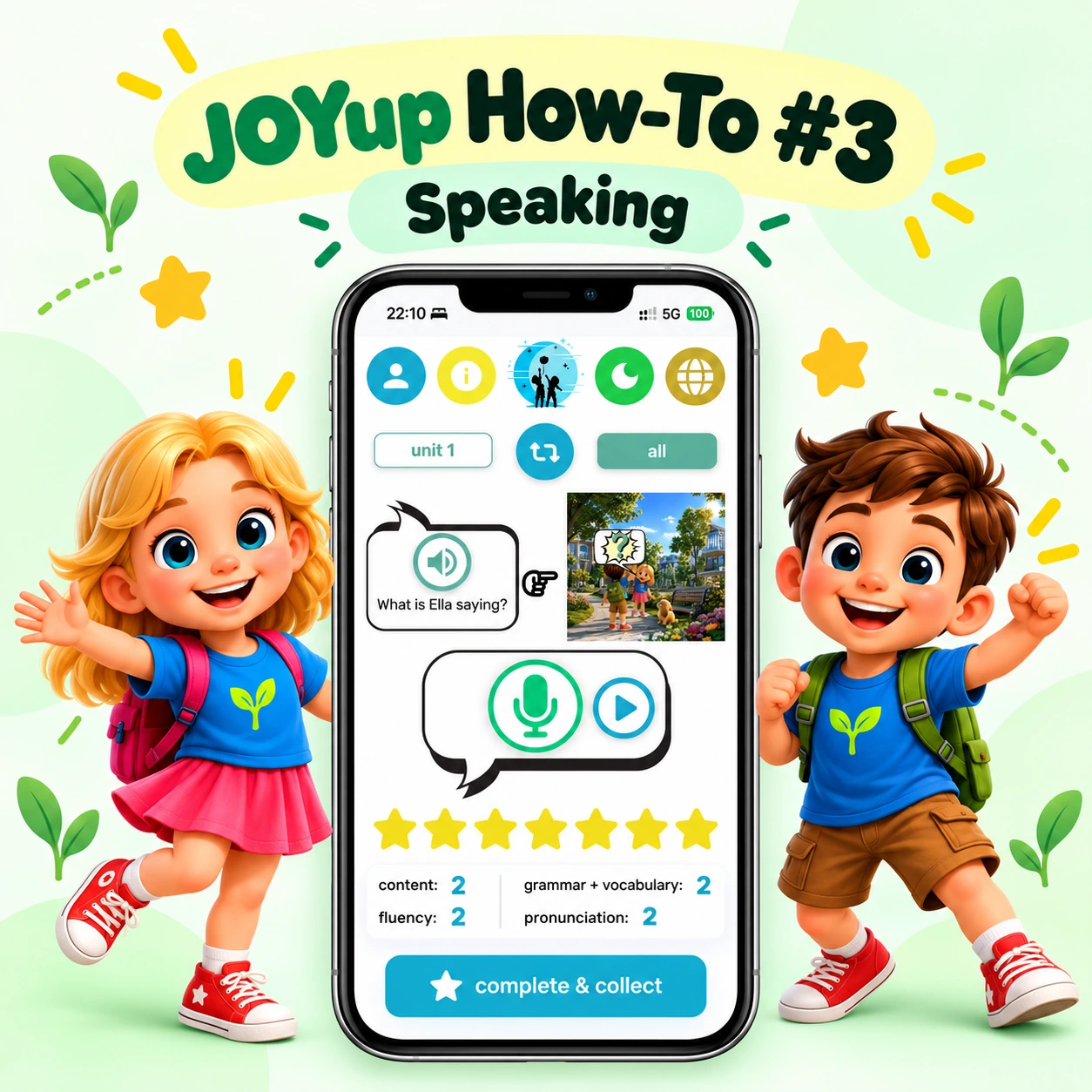
One of the most important parts of the JOYup app is the Speaking section. The activities in this section are designed to develop speaking skills and accurate pronunciation.
The learner answers a question related to an image, and the recorded response is converted into text while also being assessed for pronunciation and how well it answers the question. Each task also includes a hint, which is particularly helpful when working with new material.
From a neurolinguistic perspective, this is very important because language is reinforced most effectively when children do not simply see and hear it, but actively use it as well. Speaking requires them to recall words, build a structure, adapt it to the situation, and say it aloud.
That is a completely different level of language processing from simply clicking the correct answer.
With the Speaking section, children can practise speaking regularly in a safe environment. They do not have to speak perfectly straight away. They can try, improve, and gradually become more confident and fluent.
The Games section allows children to play with language in an engaging way. Learners receive immediate feedback, so they know straight away whether they have completed the task correctly.
This is very important from a neuroeducation perspective. Children learn more effectively when they can quickly see the result of their actions. Immediate feedback helps reinforce correct answers and allows mistakes to be corrected more quickly.
The games involve not only remembering the material but also reaction speed, logic, and concentration. This means that using the app supports development in several areas at the same time.
Children do not feel as though they are completing boring exercises. They play with the language while repeatedly returning to familiar structures, words, and sentences. This regular, enjoyable repetition helps reinforce the material in a more natural way.
The Leaderboard allows learners to compare their results with other users at the same level. The selected avatar and nickname are displayed, allowing children to take part in the competition in a safe way.
The leaderboard provides additional motivation to use the app regularly. Learners can see their progress, want to improve their results, and are more likely to return to their exercises.
At JOYup, however, competition is not the only goal. The Leaderboard also strengthens the feeling of belonging to a community with a shared objective — to master the English material as effectively as possible.
This means that learning does not feel like a solitary obligation. It becomes part of a bigger adventure in which children can see that other learners are also practising, earning points, and developing their skills.
The Learning section gives learners access to the entire curriculum in an interactive format.
The material is always available in the app. Learners can return to videos, images, recordings, familiar language structures, and flashcards whenever they need to.
The Peak section contains all the videos introducing the material covered so far. This is the stage of curiosity, emotion, and the first encounter with new language.
The Tweak section contains a list of previously learned structures — words and sentences — presented through images, recordings, and text. It is a space for practising, modifying, and gradually becoming more comfortable with the language.
The Keep section contains all the material in the form of cards — flashcards that learners can use to check their own knowledge. It is excellent preparation before starting the games and tests that assess the skills they have developed.
This structure reflects the JOYup method: first, the child discovers the material in an engaging way, then practises it in different forms, and finally reinforces it and checks whether they can use it independently.
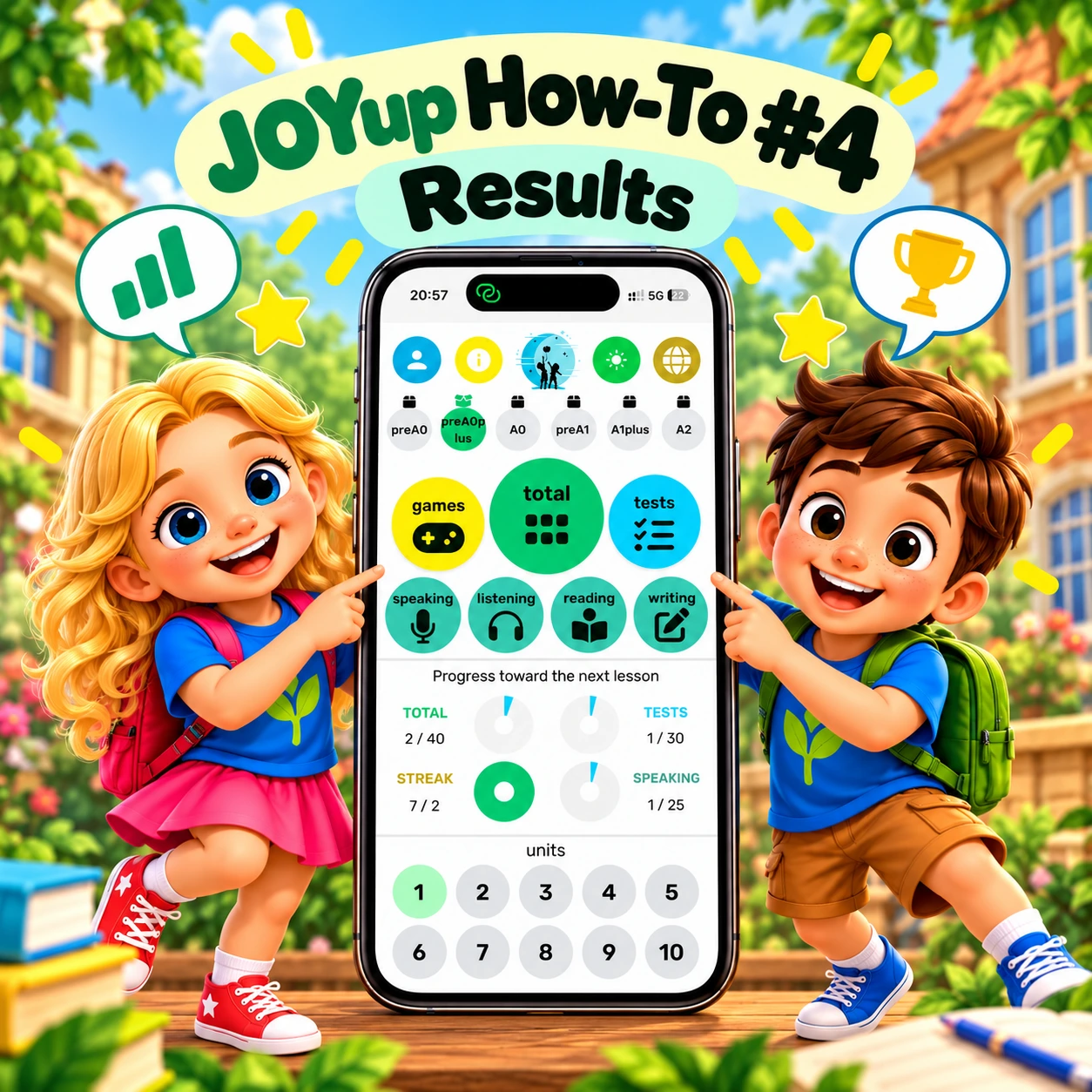
Learners have access to a progress panel in the app. It shows the child’s current CEFR level as well as all completed levels, together with a description of the skills acquired after completing each one.
These skills are aligned with Cambridge requirements. This means that both the parent and the learner can see not only a score, but also what the child is actually able to do after completing a particular stage.
The panel also shows the overall score, separate results from games and tests, scores for areas such as speaking, listening, reading, and writing, as well as results from individual units.
This is very important because an effective English learning app should present progress clearly. Children need to know that their work has a purpose, and parents should be able to see how their learning is developing.
To unlock the next lesson, the learner must reach the required number of points for the relevant level: overall points, test points, speaking points, and the required number of consecutive days spent practising — the streak.
The progress panel shows both the required points and the points already earned. This allows learners to see exactly what they have already achieved and what they still need to do to move forward.
At JOYup, we want the app to develop together with its users. That is why every user can submit feedback directly in the app on a selected topic.
We also collect suggestions for new features and improvements to existing ones. This gives users a real influence on how the JOYup app will look and develop in the future.
Users can also vote for improvements that have already been suggested. The number of votes available to each user depends on the number of points they have earned.
This strengthens engagement and shows children that their activity matters not only in their learning, but also in the development of the app itself.
The best English learning app should reflect the way children actually learn. Simply showing vocabulary and asking them to select the correct answer is not enough.
Children need:
contact with language in context,
regular repetition,
positive emotions,
active use of the language,
immediate feedback,
a sense of progress,
motivation to come back every day.
JOYup was designed with exactly these needs in mind. It combines images, sound, text, speaking, games, tests, flashcards, points, and progress tracking into one coherent learning system.
From a neuroeducation perspective, one of its strengths is that the app does not overwhelm children with one large block of material. Instead, learning is divided into smaller steps, feedback is immediate, and motivation is continually reinforced.
From a neurolinguistic perspective, the language is not presented as an isolated list of words. It appears in context — through images, recordings, questions, answers, and practical use.
As a result, English becomes more than just a subject to study. It becomes a natural part of the child’s everyday activity.