
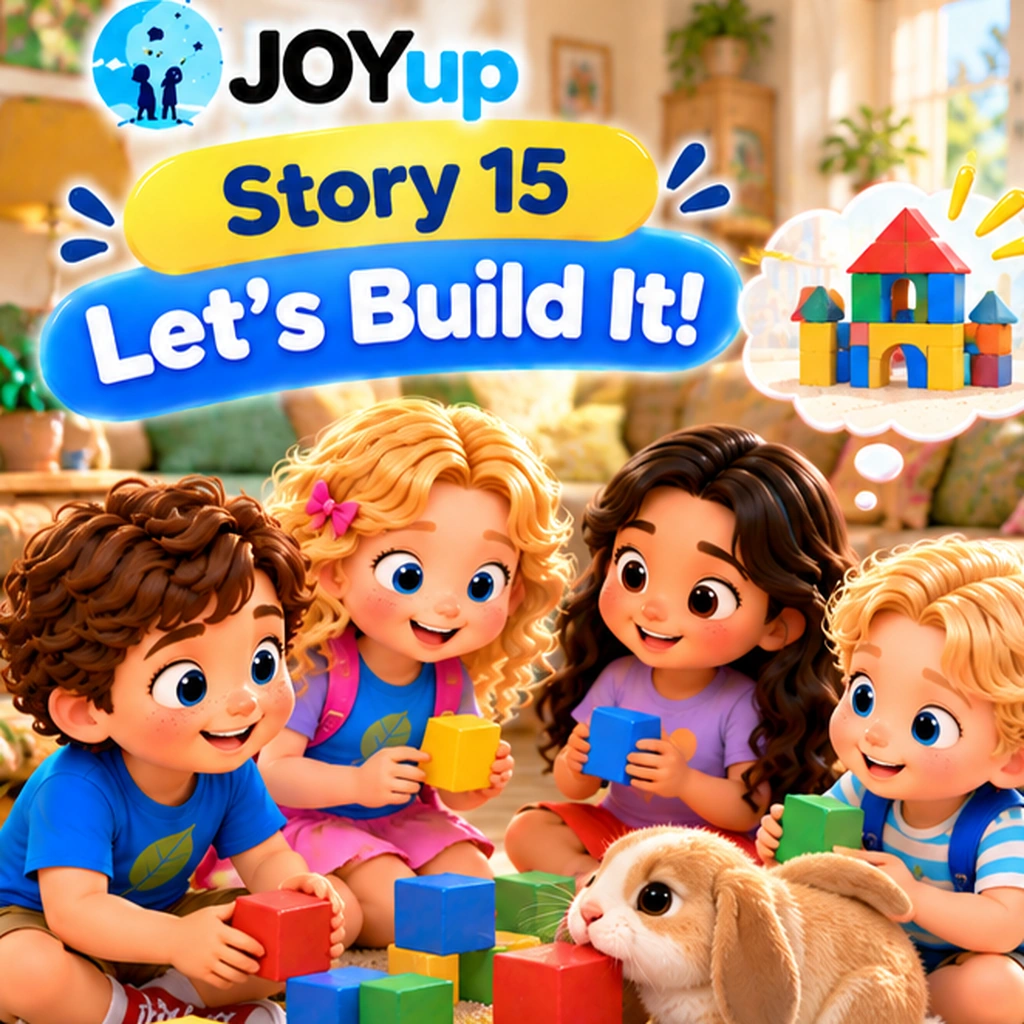
Can you build a house with just a few blocks? 🏠
In Let's Build It!, Ella, Dave, Mia and Tim are spending time with little Molly and Bunny.
Everyone has a favourite toy, and the children are excited to play together.
But when Bunny shows an interest in building blocks, the children have a new idea.
Let's build a house!
What happens in the story?
The children sit together and talk about the toys they like.
They practise simple sentences such as:
I like the robot.
I like the doll.
I like the car.
Then they discover that Bunny likes something different.
Bunny likes blocks.
The children decide to use the blocks to build a house.
They look at the colours and practise sentences such as:
It's a red block.
It's a blue block.
But building a house is not so easy.
The children count their blocks and realise that they do not have enough.
We need more blocks.
Let's find more blocks.
Then they remember that Molly has more blocks.
But suddenly, they notice something strange.
Where is Molly?
The adventure continues in Story 16!
English vocabulary and phrases from the story
In this Pre-A0+ English lesson, children practise simple words and sentences connected with toys, colours, counting and playing together.
Toys
- a teddy bear
- a robot
- a doll
- a car
- a ball
- blocks
Colours and numbers
- red
- blue
- two
- five
- six
Useful phrases
- Molly likes the teddy bear.
- I like the robot.
- Bunny likes blocks.
- It's a red block.
- It's a blue block.
- Let's build a house.
- We cannot build a house.
- We need more blocks.
- Let's find more blocks.
- Molly has more blocks.
Practise English through play
One of the easiest ways to use the language from this story is to play with building blocks at home.
You do not need any special materials — just a few colourful blocks and a little imagination.
1. Name the colours
Pick up a block and say:
It's a red block.
It's a blue block.
Encourage your child to choose another block and describe it.
2. Count the blocks
Put a few blocks on the table and count them together.
One, two, three, four, five!
Then add another block and continue counting.
3. Build something together
Start building a simple house.
Say:
Let's build a house!
If you need more blocks, use the phrase:
We need more blocks.
These short activities help children connect English with familiar objects and everyday play.
Why learn English through stories?
In JOYup, children meet new vocabulary in meaningful situations.
They see the characters, listen to their conversations and follow what happens next.
The pictures and actions provide clues that help children understand the language.
After watching the story, children can return to the same vocabulary through interactive games, listening and speaking activities in the JOYup app.
This gives them more opportunities to recognise, remember and use what they have learned.
Continue the adventure with JOYup
Will the children find Molly?
Discover what happens next in Story 16!
In the meantime, continue practising English through stories, games, vocabulary activities and speaking exercises in JOYup.
Your first lesson is free. No time limit.
Download JOYup and start learning English through play! 💚