
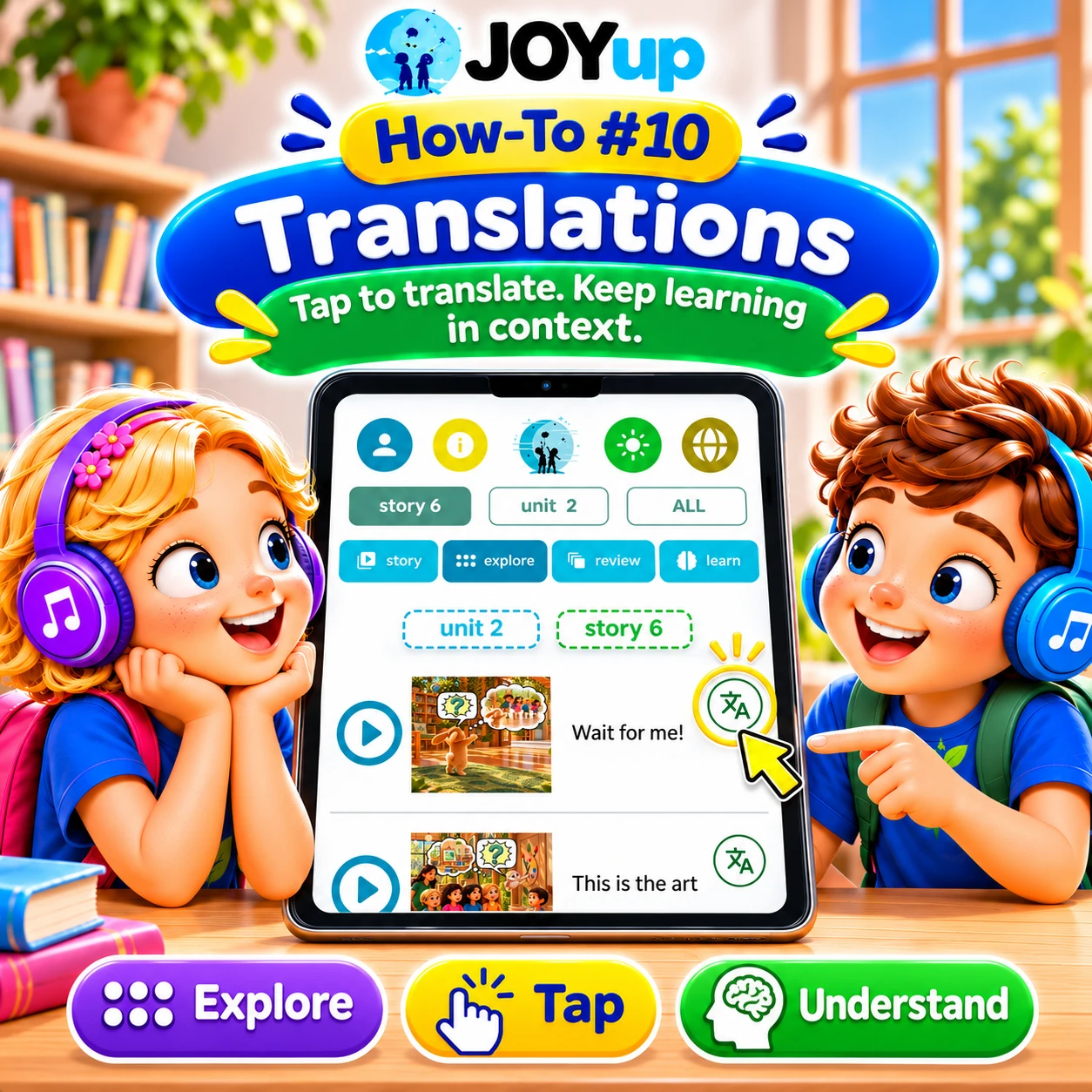
A story, a picture and a voice help learners discover meaning. Translation offers extra support when something is still unclear. Here is how these elements work together in JOYup.
A child hears ‘Wait for me!’, sees a character trying to join friends and follows the situation. The picture and voice help connect the phrase with an intention: someone wants the others to wait. A translation can confirm that understanding, but it does not have to come first.
This is the approach behind JOYup. English appears in stories and activities, with translations available as a helping hand when learners need clarification.
Why does context matter?
We use words to do things: greet someone, ask a question, express a feeling or request help. Meeting words in a situation also shows us when and why people use them.
Illustrations, characters’ actions, tone of voice and earlier events all provide clues. Learners do not always need to know every word to follow the message.
In JOYup, stories provide a context for listening, vocabulary, speaking and interactive activities. Learners can revisit familiar phrases in different ways: hearing them, recognising a matching picture and trying to say them.
What is natural language acquisition?
Natural language acquisition involves developing understanding through contact with language in meaningful situations. It draws on how we discover language in everyday life: listening, observing, making connections and gradually trying out expressions.
Learning a second language through an app is not identical to acquiring a first language. JOYup takes inspiration from these principles by connecting English with stories, pictures and actions.
Understanding is essential. Exposure alone is not enough if a learner cannot connect words with meaning. ACTFL highlights extensive use of the target language alongside strategies that support comprehension.[1]
Language immersion needs support
Language immersion means being surrounded by a language. An app can create frequent opportunities to hear and use English, although this differs in scale from a full immersion programme or everyday life in another language.
The practical aim is plenty of English whose meaning learners can discover. Clear scenes, familiar characters, recurring phrases and opportunities to listen again help. Translation offers another clue when needed.
Does translation get in the way?
No. A translation can clarify an unfamiliar expression, confirm a guess and reduce frustration. There is no need to avoid it at all costs.
Its role matters. When an entire activity consists of matching English words with equivalents in a learner’s own language, that matching is the main skill being practised. Understanding speech and using expressions independently also require practice in those skills.
Checking meanings can therefore be combined with context and active language use. Research on learning phrases in texts shows that additional explanations can support contextual learning, with benefits depending on how support is provided and on learning conditions.[2]
In JOYup, translations are a supplement, available in Explore when a sentence’s meaning is still unclear.
How to use translations in JOYup
- Open the learning section from the home screen.
- Select Explore and filter by story, unit or all available materials.
- Listen and look at the illustration. Try connecting the sentence with what you see.
- Tap the translation icon next to the sentence if you need help. Use the globe icon to choose your app language.
- Hide the translation and listen again. Return to the English phrase with a clearer understanding of its meaning.
To look more closely at a scene, double-tap the illustration to enlarge it.
Watch the How-To #10 video
The video below demonstrates where to find translations and how to use Explore.
How can parents help?
Give your child a moment to watch the scene and listen. Ask ‘What do you think the character wants?’ or ‘What in the picture helps us understand?’. If the meaning is uncertain, check the translation together.
Every scene does not need to become a test of translated equivalents. A gesture, a matching picture or an appropriate response can show understanding too. After checking the meaning, play the English sentence again and repeat it together if your child wants to.
A simple routine: listen → look → try to understand → check if needed → listen again.
Frequently asked questions
Should we translate every sentence?
No. When the picture and situation make the message clear, keep learning. Translation is there when you need an extra explanation.
Does a child need to understand every word immediately?
They do not need to explain every word straight away. What matters is being able to follow the scene. If confusion gets in the way, listen again, look at the illustration and use the available support.
Why are translations only in Explore?
This is a JOYup design choice. Explore provides space to discover and check meaning, while other activities revisit English through listening, speaking, pictures and practice.
Discover English with JOYup
Start with a story. Listen, look and check the meaning whenever you need to.
First lesson free. No time limit.
Sources and further reading
- ACTFL: Facilitate Target Language Use — using the target language with support for comprehension.
- Contextual learning and retention of phrasal verbs — research on learning in context with additional explanations.
These sources concern general language-learning principles; they are not studies of JOYup’s effectiveness.